The cold-plunge scene has produced more prescriptions than the literature can support. "Eleven minutes a week." "Three minutes a day." "End on cold." "Never end on cold." Let's separate what the research actually says from what podcasters have built on top of it.
The famous Søberg paper — what it actually showed
Søberg and colleagues published a small but widely cited study in Cell Reports Medicine in 2021 comparing 8 experienced male winter swimmers to 8 matched controls (PMID 34755128). The headline findings were that winter swimmers had a lower thermal comfort set-point, reduced brown adipose tissue glucose uptake at thermal neutrality, but enhanced cold-induced thermogenesis and stronger supraclavicular skin-temperature rise during cooling. The authors interpret this as metabolic adaptation to combined cold and heat exposure — swimmers typically did sauna alongside their cold dips.
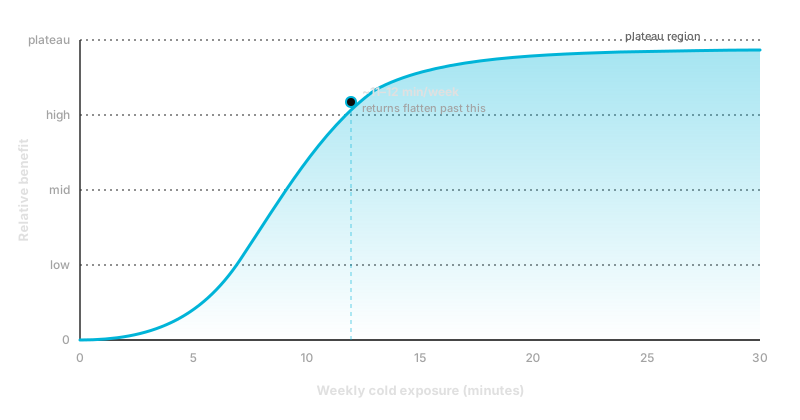
Notice what the paper does not say: it does not prescribe a minimum effective dose. It does not say "11 minutes per week." It describes a population that swam 2–3 times per week, usually with a sauna chaser. The popular "11 min cold / 57 min heat per week" framing comes from Dr. Søberg's later public communications and her appearance on the Huberman Lab podcast, where she described the minimum she sees in the cohorts she works with. That's reasonable guidance. It is not a peer-reviewed dose-response curve.
What the acute-response studies tell us
Šrámek et al. (Eur J Appl Physiol, 2000) give us the cleanest acute-physiology snapshot. One-hour head-out immersions at 14 °C in healthy young men drove:
- Metabolic rate: +350%
- Plasma norepinephrine: +530%
- Plasma dopamine: +250%
- Cortisol: unchanged
The norepinephrine rise is the mechanism behind the alertness and mood effect most plungers report. It is dose-dependent on temperature and duration — colder and longer means a bigger spike — but the curve is non-linear and the risk curve is steeper than the benefit curve.
The Espeland review (Int J Circumpolar Health, 2022; PMID 36137565) surveyed 104 studies on voluntary cold-water exposure and concluded the evidence for metabolic, cardiovascular, and immune benefits is real but limited by small samples, heterogeneous protocols, and mostly male cohorts. Translation: we know cold does something; we don't know the optimal prescription with precision.
The pragmatic protocol
Based on the available evidence, here's a defensible starting protocol. This is not medical advice.
Temperature: 10–15 °C. Colder is not better for most people; it just compresses the tolerable window. The Šrámek data used 14 °C and got a huge sympathetic response.
Duration per session: 2–5 minutes. Beginners at the 1–2 minute end. Experienced plungers cap around 5 minutes at 10 °C before the risk profile rises meaningfully.
Frequency: 2–4 sessions per week. The Søberg cohort did 2–3. Huberman's popular prescription of ~11 minutes per week total is a reasonable floor.
Timing: Morning. The norepinephrine/dopamine surge lasts hours and suits the start of the day. Avoid within 4 hours of bedtime.
Breathing: Controlled nasal breathing on entry. The cold-shock response is the leading cause of cold-water death (Tipton et al., Exp Physiol 2017); you manage it by not gasping. Exhale slowly through pursed lips for the first 30 seconds.
End on cold — or hot? For metabolic adaptation, end on cold. For post-exercise recovery combined with sauna, it doesn't matter much — the hot/cold sequence within a contrast protocol has not been shown to produce different physiological outcomes in the available studies.
The safety floor
The cold-shock response is the single most important risk. Tipton's review breaks it into four phases: initial cold shock (first 30 seconds: hyperventilation, tachycardia, hypertension), short-term incapacitation, hypothermia, and circum-rescue collapse. For a 2–5 minute supervised plunge in a controlled tub, you're dealing almost exclusively with phase 1. The fix: controlled breathing, never dunk your head until you've acclimated, don't plunge alone for your first dozen sessions.
Hard contraindications include uncontrolled hypertension, recent cardiac events, pregnancy without clearance, Raynaud's, and any history of cold urticaria.
The reality check
Much of what you read about cold plunging rests on 8-person studies and podcast extrapolations. That doesn't mean the practice is wrong — it means the specific numbers are soft. Don't chase 2.1 °C for 4 minutes and 19 seconds because some blog said that's optimal. Hit a reasonable window consistently: 10–15 °C, 2–5 minutes, 2–4 times a week, morning, with sauna or a warm shower if you like, for 12 weeks. Then see how you feel.
Track this with SnowFire. The app auto-detects water temperature on Apple Watch, logs your exact duration, shows your weekly cold minutes against the Søberg-Huberman threshold (11 min target), and stitches sauna + plunge into single contrast sessions. You can pick the Søberg protocol as a guided session and the app will coach duration and ring progress.
FAQ
Is "11 minutes per week" from the Søberg paper? No. It's a framing Dr. Søberg and Andrew Huberman popularized in public communications. The 2021 paper describes a cohort that swam 2-3 times per week with sauna; it does not prescribe a threshold.
How cold should the water be? 10–15 °C is the most-studied window. Colder compresses your tolerance and steepens the risk curve.
How long is one session? 2-5 minutes. Beginners shorter.
Morning or evening? Morning for the alertness effect; avoid within 4 hours of sleep.
Do I need to go daily? No. 2-4 per week is sufficient in the data we have.
References
- Søberg S et al. Cell Rep Med. 2021;2(10):100408. PMID: 34755128. DOI: 10.1016/j.xcrm.2021.100408.
- Espeland D, de Weerd L, Mercer JB. Int J Circumpolar Health. 2022;81(1):2111789. PMID: 36137565.
- Šrámek P et al. Eur J Appl Physiol. 2000;81(5):436-442. PMID: 10751106.
- Tipton MJ et al. Exp Physiol. 2017;102(11):1335-1355. PMID: 28833689.