The case for sauna and cold plunge is usually made at the clinical level — mortality reduction, recovery, mood. The more interesting story is one level down: what's actually happening in your cells when you deliberately impose heat or cold stress. This is where hormesis, heat shock proteins, and cold shock proteins live. It's also where the research is strongest for mechanism and weakest for human dose-response.
Here's the molecular biology, honest about what we know.
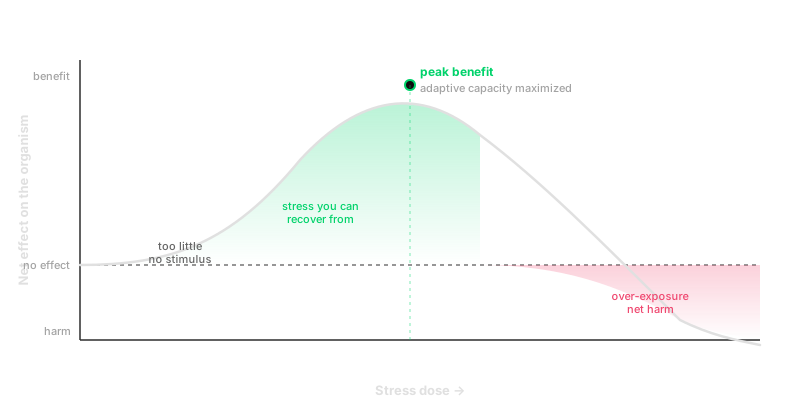
Hormesis, defined properly
Mark Mattson's 2008 paper Hormesis defined (Ageing Res Rev, PMID 18162444) is the starting point. Hormesis is "an adaptive response of cells and organisms to a moderate, usually intermittent, stress." The stress triggers upregulation of cytoprotective proteins via pathways involving Nrf2, NF-κB, sirtuins, and kinases. Low dose: beneficial. High dose: damaging. The curve is biphasic.
This is not wellness culture. It's how exercise works, how caloric restriction works, how phytochemicals with mildly toxic profiles (sulforaphane, curcumin) exert their effects. The thermal therapies fit the same frame.
Heat shock proteins: HSP70 and HSP90
Heat shock proteins are molecular chaperones. They fold nascent proteins, refold damaged ones, and shuttle misfolded proteins to degradation. HSP70 (constitutive HSC70 and inducible HSP72) is the workhorse. HSP90 regulates a large set of signaling proteins including steroid receptors and kinases.
In humans, Iguchi et al. (2012; J Athl Train, PMID 22488284) exposed 25 adults to 30 minutes of 73 °C passive heat and measured a significant rise in extracellular HSP72, alongside norepinephrine, prolactin, and cortisol. Core temperature rose 0.82 °C, heart rate reached ~66% of age-predicted max. That's sauna-level heat and it moves HSP72 measurably.
McClung et al. (2008; Am J Physiol Regul Integr Comp Physiol, PMID 17977914) showed that 10 days of exercise-heat acclimation raised baseline HSP72 and HSP90 in peripheral blood mononuclear cells. Chronic thermal exposure shifts the set-point, not just the acute response.
Scoon et al. (2007; J Sci Med Sport, PMID 16877041) took competitive male runners through three weeks of post-exercise sauna (~31 min at 90 °C). Time-to-exhaustion improved ~32%, with plasma and red-cell volume expansion. HSPs weren't measured directly in that study, but the training effect is consistent with heat-acclimation biology.
The broader picture — surveyed in the Laukkanen group's Mayo Clinic Proceedings 2018 review — is that sauna likely upregulates HSP expression, improves endothelial function, reduces arterial stiffness, and modulates inflammation. The direct human data on HSPs from sauna specifically is thinner than most wellness content suggests, but the mechanism is textbook.
Cold shock proteins: RBM3 and CIRP
The cold side of the story is dominated by two proteins.
RBM3 (RNA-binding motif protein 3) is the neuroprotective star. Peretti, Bastide, Radford et al. published in Nature in 2015 (PMID 25607368) that in 5XFAD and prion-infected mice, cooling-induced RBM3 expression rescued synapse regeneration, prevented neuronal loss, and prolonged survival. Knocking RBM3 out abolished the protection. This is a clean mechanistic demonstration that cold-induced protein expression preserves synaptic architecture under neurodegeneration pressure.
The translational caveat is important: the mouse data used deep, prolonged cooling (32 °C body temperature for hours). Human cold-plunge exposure doesn't drop core temperature that far. Whether brief cold plunges induce meaningful RBM3 in human brain tissue is unknown. The molecule exists in humans, is cold-inducible, and plausibly matters — but direct human dose-response data don't exist yet.
CIRP (cold-inducible RNA-binding protein) is more complex. Zhong et al. (2021; Scand J Immunol, PMID 32738154) reviewed CIRP's dual role: intracellularly it supports cell survival under stress; extracellularly, released from stressed cells, it functions as a damage-associated molecular pattern (DAMP) that can drive inflammation via TLR4. So CIRP is not cleanly "good" or "bad" — its biology depends on location. Another reason not to oversimplify the "cold = more protective proteins = healthier" story.
Where the hype exceeds the evidence
Be skeptical of these specific claims:
- "A 3-minute cold plunge boosts RBM3." The Peretti data are mouse, deep cooling, hours. Human cold-plunge induction of RBM3 is not well characterized.
- "Sauna mimics exercise via HSP70." The proteins overlap but the effects don't. Exercise does 50 things sauna doesn't (glucose uptake, mitochondrial biogenesis, muscle protein synthesis). Sauna is complementary, not substitutive.
- "The Finnish longevity effect is caused by HSPs." Plausible contributor, not proven mechanism. Cardiovascular training effects, blood pressure reduction, and autonomic balance are at least as likely drivers.
The practical takeaway
Hormetic stress works when it's a pulse, not a siege. A sauna session of 20-30 minutes at 80-90 °C, 2-4 times per week, is a well-characterized hormetic dose. A cold plunge of 2-5 minutes at 10-15 °C, 2-4 times per week, is the cold-side analog. Both likely shift your proteostatic machinery toward higher baseline chaperone activity. The mechanism story is strong; the exact prescription for maximum HSP/RBM3 induction in humans is still being worked out.
Track this with SnowFire. The app frames your weekly thermal exposure — both hot and cold — against published dose thresholds (Søberg, Laukkanen/KIHD, Huberman). You see cumulative minutes per modality, session intensity via heart rate/HRV, and whether your pattern matches the hormetic "pulse + recovery" shape or has drifted into chronic stress territory.
FAQ
Does sauna really induce heat shock proteins in humans? Yes. Iguchi 2012 showed extracellular HSP72 rises after a single 30-minute heat exposure. McClung 2008 showed baseline HSP72/HSP90 shifts with 10-day heat acclimation.
What are cold shock proteins? RBM3 and CIRP. Both are RNA-binding proteins induced by cold. RBM3 is strongly neuroprotective in animal models. CIRP is dual-role.
Is hormesis legit? Yes. Mattson's 2008 paper is the canonical definition.
How hot or cold do I need to get? HSP72 rises after ~30 min at 73 °C in humans. Human RBM3 induction from brief cold plunges is not yet well characterized.
Are more HSPs always better? No — chronic HSP elevation associates with some cancers. The beneficial pattern is pulse-rest.
References
- Mattson MP. Ageing Res Rev. 2008;7(1):1-7. PMID: 18162444. DOI: 10.1016/j.arr.2007.08.007.
- Iguchi M et al. J Athl Train. 2012;47(2):184-190. PMID: 22488284.
- McClung JP et al. Am J Physiol Regul Integr Comp Physiol. 2008;294(1):R185-191. PMID: 17977914.
- Scoon GS, Hopkins WG, Mayhew S, Cotter JD. J Sci Med Sport. 2007;10(4):259-262. PMID: 16877041.
- Peretti D et al. Nature. 2015;518(7538):236-239. PMID: 25607368. DOI: 10.1038/nature14142.
- Zhong P et al. Scand J Immunol. 2021;93(1):e12949. PMID: 32738154.
- Laukkanen JA, Laukkanen T, Kunutsor SK. Mayo Clin Proc. 2018;93(8):1111-1121. PMID: 30077204.