Contrast therapy — the deliberate cycling between heat and cold — shows up everywhere from Finnish bathing culture to NBA training rooms. The claim is that alternating vasodilation and vasoconstriction drives faster recovery, lower inflammation, and a kind of cardiovascular training effect. The research is messier than the influencer take, but the signal is real. Here's what we actually know, what the best studies say, and how to design a protocol you can actually execute.
What happens in the body when you alternate hot and cold
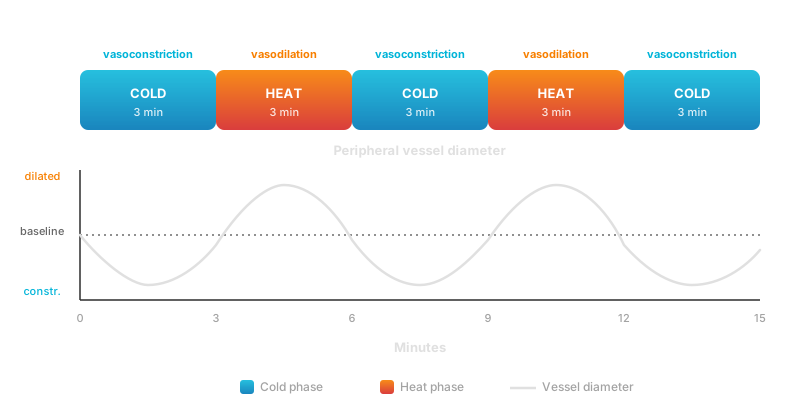
Heat exposure opens peripheral vessels. Skin blood flow rises, plasma volume expands, and the cardiovascular system works to dump heat. Cold exposure does the opposite — peripheral vasoconstriction shunts blood to the core, heart rate and blood pressure spike via a sympathetic surge, and norepinephrine rises sharply. Šrámek and colleagues measured a 530% increase in plasma norepinephrine and a 350% increase in metabolic rate during a one-hour 14 °C immersion in healthy young men (Eur J Appl Physiol, 2000).
Alternate the two fast enough and you force the vasculature to flip between constriction and dilation. The working hypothesis — endorsed by Mooventhan and Nivethitha's broad hydrotherapy review (N Am J Med Sci, 2014) — is that this "muscular pump" effect on the vessel wall improves circulation and lymphatic flow while the sympathetic/parasympathetic flips train autonomic flexibility. Think of it as interval training for the cardiovascular system, imposed through temperature rather than exertion.
The recovery evidence
For exercise recovery specifically, contrast water therapy (CWT) has the strongest evidence base. Bieuzen, Bleakley, and Costello's 2013 meta-analysis pooled 18 trials and found CWT significantly reduced muscle soreness and strength loss at 24, 48, 72, and 96 hours post-exercise versus passive recovery (PLOS ONE, 2013). The catch: CWT was not clearly superior to cold-water immersion alone, active recovery, stretching, or compression. The authors also flagged that most included trials had a high risk of bias.
Higgins, Greene, and Baker (J Strength Cond Res, 2017) replicated this pattern in team-sport athletes — CWT and CWI both beat passive recovery for perceived recovery, with broadly similar effect sizes.
So a reasonable summary: if you're going to do something for recovery, contrast is as good as cold alone, and both beat doing nothing. The extra hot phase is probably worth it for comfort and adherence, which matters more than most studies measure.
The dose: how long, how hot, how cold
Versey, Halson, and Dawson's review in Sports Medicine (2013) lays out the pragmatic protocol: cold at 10–15 °C, hot at 38–40 °C, roughly 1 minute each, totaling about 15 minutes, in a 1:1 ratio. They found no clear dose-response beyond that window — more time didn't translate to more benefit in the studies available.
A sauna-then-plunge variant (95 °C sauna for 10–15 min, 10 °C plunge for 1–2 min, repeat 2–3 rounds) is the traditional Finnish framing. Physiologically it's the same principle at different temperature magnitudes. There's no RCT proving the sauna-plunge version is superior to water-based contrast; the studies just haven't been run.
What contrast therapy probably doesn't do
A few claims deserve sober handling:
- "Flushes toxins." No. The lymphatic pump effect is real mechanically but "toxins" is not a pharmacologic concept. Your liver and kidneys handle clearance.
- "Burns fat." Cold exposure has mild thermogenic effects via brown adipose tissue — we cover this in our cold plunge protocol guide. Adding heat doesn't boost that pathway.
- "Boosts immunity." Mixed evidence. The Ice Barrel–era claim that contrast therapy prevents colds is not supported by good trials. Finnish sauna bathing shows respiratory-disease reduction in observational data, but that's heat alone (see our sauna longevity article).
A practical contrast therapy protocol
Start here and adapt. None of this is medical advice; if you have cardiovascular conditions, talk to your doctor — the cold-shock response is a real risk and the Tipton review in Exp Physiol (2017) is sobering reading.
- Sauna or hot bath: 10–12 minutes at 80–95 °C (sauna) or ~40 °C (bath).
- Cold plunge or shower: 1–2 minutes at 10–15 °C.
- Repeat 2–3 rounds. End on cold.
- Total session: 30–45 minutes. 2–4 times per week.
Track this with SnowFire. The app auto-detects your cold plunge water temperature on Apple Watch, logs sauna duration with HealthKit integration, and scores your weekly contrast minutes against the research-backed targets. Your contrast cycles get stitched into a single session log with heart rate curve, HRV response, and a color-coded weekly ring.
What to watch for next in the research
The missing piece is large RCTs comparing sauna-plunge to water-based contrast to cold alone, with metabolic and cardiovascular outcomes, not just perceived recovery. The Finnish groups (Laukkanen lab) have strong sauna data; what we need is their cold-plunge equivalent. Until then, contrast therapy remains a plausible, low-risk, well-tolerated recovery tool — and one of the most enjoyable things you can do for 30 minutes.
FAQ
Is contrast therapy better than cold plunge alone? For athletic recovery, evidence shows contrast water therapy is comparable to cold-water immersion alone — both beat passive rest. For metabolic adaptation and brown fat activation, cold alone is the better-studied stimulus.
How long should each hot and cold phase be? The most commonly studied protocol uses roughly 1-minute hot / 1-minute cold cycles totaling about 15 minutes.
Should I end on hot or cold? Cold for inflammation or sleep prep; hot for relaxation. Recovery studies typically end on cold.
Is it safe with heart conditions? Ask your doctor. Rapid heat-to-cold transitions drive sharp sympathetic surges, including the cold-shock response documented by Tipton et al. (2017).
References
- Mooventhan A, Nivethitha L. N Am J Med Sci. 2014;6(5):199-209. PMID: 24926444. DOI: 10.4103/1947-2714.132935.
- Bieuzen F, Bleakley CM, Costello JT. PLoS One. 2013;8(4):e62356. PMID: 23626806. DOI: 10.1371/journal.pone.0062356.
- Versey NG, Halson SL, Dawson BT. Sports Med. 2013;43(11):1101-30. PMID: 23743793. DOI: 10.1007/s40279-013-0063-8.
- Higgins TR, Greene DA, Baker MK. J Strength Cond Res. 2017;31(5):1443-1460. PMID: 27398915. DOI: 10.1519/JSC.0000000000001559.
- Šrámek P et al. Eur J Appl Physiol. 2000;81(5):436-442. PMID: 10751106.
- Tipton MJ et al. Exp Physiol. 2017;102(11):1335-1355. PMID: 28833689. DOI: 10.1113/EP086283.