Finland is the closest thing medicine has to a natural experiment on sauna bathing. Roughly 99% of adult Finns use saunas regularly. For three decades, Jari Laukkanen's group has tracked 2,300 middle-aged Finnish men in the Kuopio Ischemic Heart Disease Risk Factor Study (KIHD) and reported some of the most cited — and most frequently misunderstood — longevity data in the wellness space.
The findings are real. The interpretation requires care. Here's what the evidence says, what it doesn't, and how to turn it into something you can actually track.
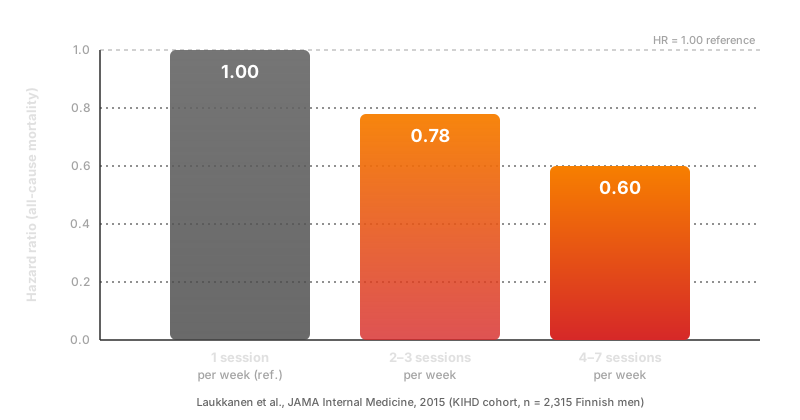
The mortality data
The landmark paper is Laukkanen, Khan, Zaccardi, and Laukkanen (JAMA Internal Medicine, 2015; PMID 25705824). Among 2,315 Finnish men followed for 20.7 years, sauna frequency was inversely associated with sudden cardiac death, fatal coronary heart disease, fatal cardiovascular disease, and all-cause mortality. Compared with 1 sauna session per week:
- 2–3 sessions/week: ~22% lower sudden cardiac death, ~7% lower all-cause mortality.
- 4–7 sessions/week: ~63% lower sudden cardiac death, ~40% lower all-cause mortality.
- Session duration >19 minutes also associated with lower risk.
Before anyone tattoos "4-7 per week" on their forearm: this is observational. Men who sauna 4-7 times a week are different from men who sauna once a week in dozens of ways the authors did their best to adjust for. The association is large and dose-responsive, which strengthens the causal plausibility, but it is not proof.
The dementia data
Three years later the same group published in Age and Ageing (Laukkanen T et al., 2017; PMID 27932366). Over 20.7 years, men who used a sauna 4-7 times per week had a hazard ratio of 0.34 for dementia and 0.35 for Alzheimer's disease versus men who used a sauna once a week. Again — observational, dose-responsive, large effect size, plausible mechanisms (cardiovascular protection, heat shock protein induction, BDNF), but not a randomized trial.
Respiratory, hypertension, and the broader review
Kunutsor et al. (Eur J Epidemiol, 2017; PMID 28905164) reported that 4+ sauna sessions per week was associated with a ~41% lower risk of respiratory diseases (COPD, asthma, pneumonia) in the same cohort. Zaccardi et al. (Am J Hypertens, 2017; PMID 28633297) reported lower incident hypertension with higher sauna frequency.
The Mayo Clinic Proceedings review (Laukkanen JA, Laukkanen T, Kunutsor SK, 2018; PMID 30077204) pulls all of this together. The proposed mechanisms: improved endothelial function, lower blood pressure, better autonomic balance, heat-shock-protein induction, and cardiovascular training effects from the heart-rate elevation during a sauna session, which can reach 100-150 bpm — comparable to moderate-intensity exercise.
Hussain and Cohen's systematic review (Evid Based Complement Altern Med, 2018; PMID 29849692) aggregated 40 clinical studies (n=3,855) and found generally beneficial cardiovascular, rheumatologic, and respiratory effects from dry sauna, though most individual trials were small.
The dose
The most-studied protocol looks like this:
- Temperature: 80–100 °C (dry Finnish sauna).
- Duration per session: 15–30 minutes. Sessions >19 minutes associated with larger mortality benefits in KIHD.
- Frequency: 2-3 sessions per week is good. 4-7 is where the strongest signal sits.
- Humidity: Low (dry sauna). Löyly — intermittent water on the stones — is fine.
If you can only do one or two sessions a week, that's still materially better than zero in the observational data. Don't let perfect be the enemy of hot.
What the evidence doesn't say
Three caveats worth stating out loud.
Observational, not causal. KIHD is strong for a cohort study — long follow-up, large n, careful adjustment — but it can't rule out residual confounding. The men who sauna 4-7x/week may have other protective habits we can't fully capture.
Finnish men specifically. The cohort is middle-aged Finnish men. Whether the effect size replicates in women, different ethnicities, or younger adults is extrapolation.
Infrared is not in this dataset. The mortality numbers are for traditional dry Finnish sauna. Infrared has separate, smaller evidence — interesting, less definitive.
A practical sauna protocol
Start at 2-3 sessions per week. Build to 4 if time allows. Sessions of 20-30 minutes at 80-90 °C. Hydrate before and after. No alcohol in the sauna (the epidemiology on sauna-related cardiac events is almost entirely about alcohol). If you have cardiovascular disease, get clearance.
Pair with cold exposure if you want — see our contrast therapy article and the heat shock protein article for the molecular rationale.
Track this with SnowFire. The Apple Watch integration captures heart rate and HRV through the session and scores your weekly frequency against the KIHD 4-7× threshold. You'll see your longest streak, session-duration histogram, and a color-coded weekly ring. It turns "I sauna sometimes" into "I've hit the KIHD threshold 9 weeks running."
FAQ
How many sauna sessions per week for longevity benefits? 4-7 showed the largest effect in KIHD; 2-3 showed meaningful benefits too.
Does the evidence prove sauna causes longer life? No — observational data, not RCTs. Strong association, not proof.
How long should a session be? 15-30 minutes at 80-100 °C. Sessions >19 minutes associated with the largest benefits.
Infrared as good as Finnish? The mortality data are on traditional dry sauna. Infrared has its own, smaller evidence base.
Any risks? Dehydration, orthostatic hypotension, alcohol interaction. Events in healthy adults are rare.
References
- Laukkanen T, Khan H, Zaccardi F, Laukkanen JA. JAMA Intern Med. 2015;175(4):542-548. PMID: 25705824. DOI: 10.1001/jamainternmed.2014.8187.
- Laukkanen T, Kunutsor S, Kauhanen J, Laukkanen JA. Age Ageing. 2017;46(2):245-249. PMID: 27932366. DOI: 10.1093/ageing/afw212.
- Laukkanen JA, Laukkanen T, Kunutsor SK. Mayo Clin Proc. 2018;93(8):1111-1121. PMID: 30077204.
- Kunutsor SK, Laukkanen T, Laukkanen JA. Eur J Epidemiol. 2017;32(12):1107-1111. PMID: 28905164.
- Hussain J, Cohen M. Evid Based Complement Altern Med. 2018;2018:1857413. PMID: 29849692.
- Zaccardi F et al. Am J Hypertens. 2017;30(11):1120-1125. PMID: 28633297.